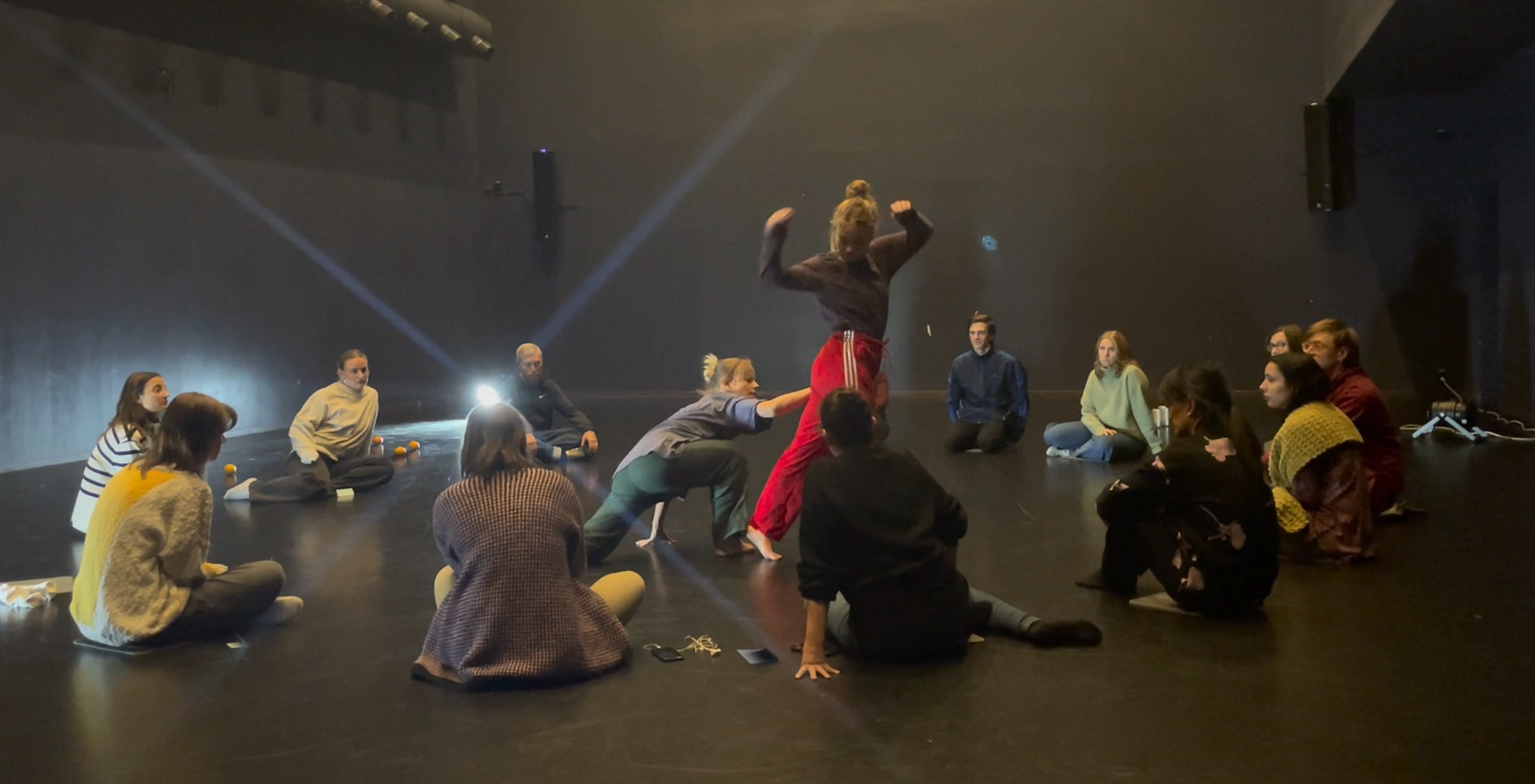
Excerpts of a self interview on How should a dancer be? Stockholm University of the arts, 2024
A: But can I ask what your PhD-project about and how do you engaged with it in your solo?
AA: My PhD-project is a comparative study of artistic trajectories in Norway and Hungary – two politically very different countries. So, in the solo I wanted to mix materials from my PhD project, which meant interviews with the artists and also included autoethnography material. I didn’t want the dance solo/piece to be about my PhD project. Rather, I wanted to engage in an artistic process where I used the interviews from my PhD-project, but in combination with other ideas, such as relating to my own dance history, to the format of the solo, to the social situation of the course and the teachers and students I engaged with there. I wanted all these elements to affect each other, and be confused about what was directing what, to experiment with what an artistic process could be, different from an academic one. I even wrote about my coming solo in my PM for the course in dance and philosophy and Josefine Wikström encouraged me to use Cvejics definition of problem to move forward with my solo work, which I did. I was also trying to think about how the choreographic work and the dancing perhaps could give something back to my sociological research – which remains and open question.
A: What were the ‘problems’ you worked with?
AA: Another important problem was the task itself, of making a solo dance. It made me embarrassed even to think about making a solo, but I wasn’t quite sure why, and I don’t know if I really have found out either – perhaps it relates to how I relate to the idea of making a solo to an audition context, or somehow something too personal, or how I don’t find it so obvious what a danc solo is supposed to be and perhaps thinking others might have a clearer idea of it. Anyhow, I started to look at the dance solo in a historical context, reading texts about that, about for example how the dance within modern or contemporary dance might differ from ballet or other art forms due to how it is a very solitary thing, in ballet the solo is in relation to the corps de ballet, and in other art forms there is a relationship between the painter and the canvas, or the writer and the text or book. Although I don’t know if I agree with this claim – the dancer is always in relation to something. As Steve Paxton allegedly said: “Solo dancing does not exist: the dancer dances with the floor: add another dancer and you have a quartet: each dance with the other and each with the floor.” And we will also always include others in making a solo, and including references, ideas etc. But still, making a solo is different from making a collective piece. And personally, I like working with other people more than working by myself. As a PhD student I sociology I have enough alone time as it is, I dontfind my self that interessting, and in artistic work working together with other people is what makes it fun and meaningful to me. So, this was my first problem: how to relate to making a solo, in relation to finding strategies to not work alone, and in terms of working with the format of a solo as a friction or tension. I tried to find a way to work within a solo format, but to stretch its boundaries. I started to ask people around me for different things, to give me a song, to sit together and make embroidery that I would perhaps use as a prop, and to work together with someone talking about what I was doing. These things are perhaps not very revolutionary in terms of an artistic process, but I wanted to make the inclusion of other people in my solo more explicit to myself. To think actively about my relation to other people in the process of and in the execution of the solo. I got the costume in the solo from another students solo for instance. I also wanted to include the audience in my solo explicitly. I was planning to engage the audience in terms of participating in different ways, because I was interested in directing attention in a specific way where they would look at me, but also split their attention, and observe each other and themselves in the situation – in that way I would also not be alone as a performer, the audience would also take part. I thought about this as ‘meaningful distractions’, which meant that I wanted to distract the audience a bit from watching me, but make these distractions meaningful, to give it content, and not being just form. I did this in terms of giving the audience notes with instructions of reading text material from my statements on the artistic trajectories for example.